
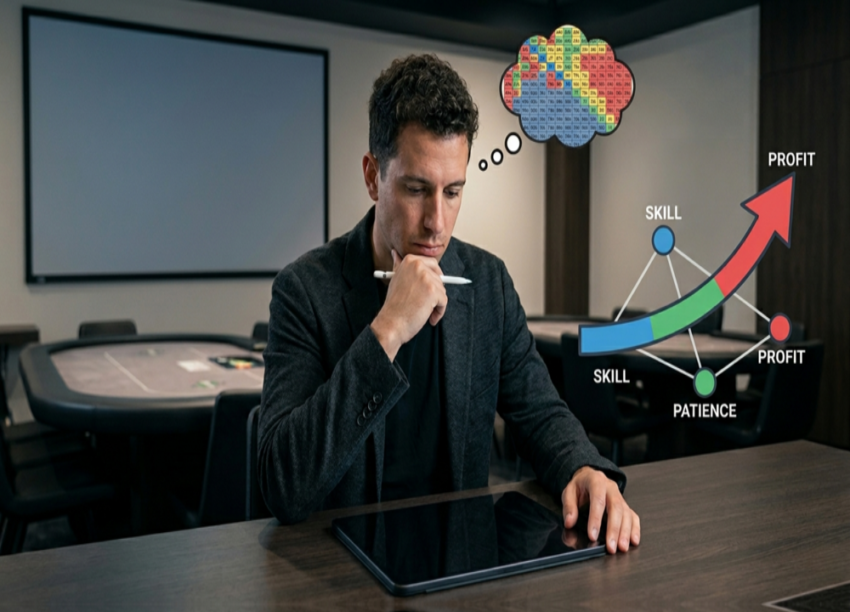
If you open up Twitter, click on a Twitch poker stream, or watch a live vlog, it won’t take you five minutes to hit the wall of colorful pie charts. They are everywhere.
The modern poker community has become entirely obsessed with a piece of software called GTO Wizard. The narrative being pushed down our throats by coaches, influencers, and the company’s massive affiliate army is as relentless as it is terrifying: “Game Theory Optimal is the only way to survive. If you aren’t paying for the software, you’re losing out. You are a dinosaur waiting for the asteroid.”
It is a beautiful piece of marketing. It is also, from where I sit, a massive psychological illusion.
I am a micro and low-stakes player. My bread and butter is mixed games—Stud, Omaha Hi-Lo, Razz, Triple Draw—though I play my fair share of No-Limit Hold’em too. And I’m going to let you in on a secret that the poker industrial complex doesn’t want you to believe: I have won money consistently over a long period of time without ever spending a single dollar on a GTO subscription.
I don’t study charts until my eyes bleed. I don’t gamify my anxiety with trainer scores. And I’m doing just fine. Here is an honest look at why the “GTO or bust” marketing engine is a brilliant corporate trap, why it breaks down in the real world, and why the human element is still the most profitable thing in poker.
1. The Anatomy of a Masterclass Marketing Trap
Let’s give credit where it’s due: the marketers behind tools like GTO Wizard are absolute geniuses. They managed to pull off the ultimate SaaS (Software as a Service) magic trick.
Historically, solvers were clunky, hard-to-use programs that required high-end computer rigs with massive RAM. They were a luxury tool for the top 1% of high-stakes grinders. GTO Wizard’s commercial brilliance was moving all that heavy computing to the cloud, wrapping it in a sleek interface, and selling it as a recurring monthly subscription.
But you can’t build a massive, scaling software company if your only customers are world-class pros. You need the masses. To get the masses, they had to weaponize two of the most powerful forces in human psychology: Fear and Identity.
- Weaponized FOMO: They successfully shifted the cultural narrative from “Use this to get an elite edge” to “If you don’t pay us every single month, you are literally giving your chips away.” They created an existential dread in the average amateur.
- The Seduction of Certainty: Poker is a brutal, volatile game. You can play a hand perfectly, lose your stack to a two-outer, and drive home questioning your sanity. GTO Wizard stepped in as an emotional cushion. They gave players a “Score Card.” If you lose a massive pot, but the trainer mode tells you your play was 98% mathematically accurate, your ego is safe. You aren’t buying a calculator; you are buying emotional insurance against bad beats.
2. The Great Mathematical Disconnect
Here is the irony that cracks me up every time I see a low-stakes player obsessing over pre-flop ranges down to the decimal point: Strict GTO is structurally designed to leave money on the table against bad players.
Mathematically, a solver calculates a Nash Equilibrium. It creates a defensive, un-exploitable strategy based on the absolute assumption that your opponent is also a flawless, un-tiltable machine.
But have you ever looked at a low-stakes table? Have you ever played on an online poker site or walked into a local casino room? It isn’t populated by GTO bots. It is populated by human beings.
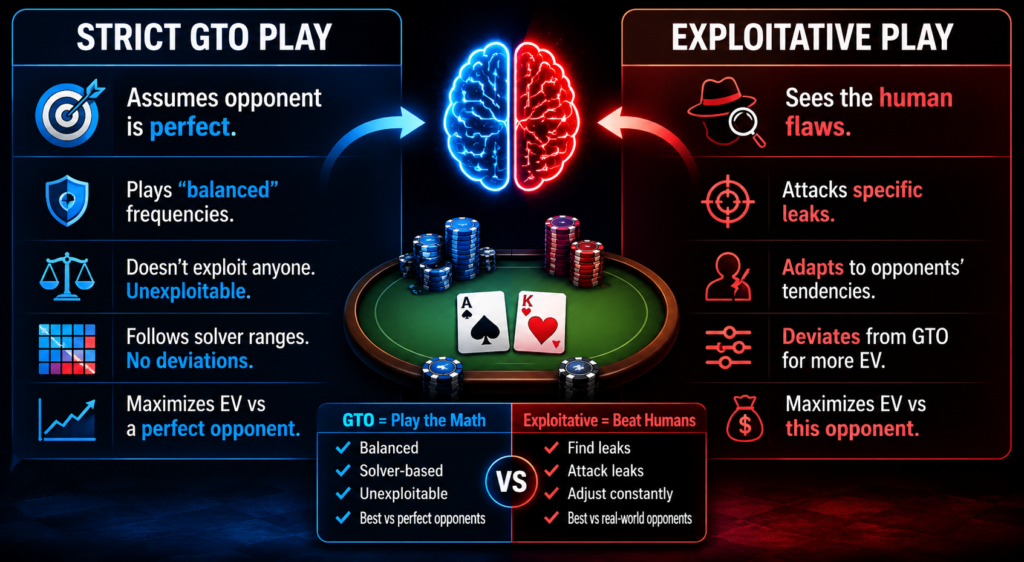
If a recreational player at my table is folding 65% of the time to a continuation bet on the flop when the math says he should only fold 40%, a strict GTO strategy will tell me to keep bluffing at a controlled, balanced frequency. Why? To keep from being exploited.
But I don’t need to worry about being exploited by a guy who is drinking a beer and watching a football game on the wall. An exploitative strategy says: “Lock that node, throw balance out the window, and bluff him 100% of the time until he proves he can adjust.”
By trying to play like a robotic AI agent, modern players are capping their own win rates against the exact people who keep the poker ecosystem alive.
3. The Street-Fighting Freedom of Mixed Games
This GTO tunnel-vision gets even funnier when you step outside the No-Limit Hold’em bubble. As a mixed-game player, I watch the “chart-checkers” completely unravel when they have to play games like Limit Omaha Hi-Lo or Razz.
Why? Because you can’t just pull up a cloud-solved recipe on your phone and mirror it. Mixed games require you to actually think on your feet. They force you to read the human across from you, calculate shifting equities on the fly, and understand the raw psychology of pressure.
| Playstyle Dimension | The GTO Clone | The Street-Fighting Human |
| Primary Focus | Mathematical balance & frequencies | Spotting physical and behavioral leaks |
| Adaptability | Rigid adherence to the “solved” tree | Fluid adjustments based on table dynamics |
| Low-Stakes Focus | Minimizing personal mistakes | Actively punishing the opponent’s mistakes |
When everyone studies the same software, their strategies become identical. The fields homogenize. They trade blinds, they split pots, and their raw edges against each other shrink to almost nothing. And do you know who wins when everyone plays the same way? The software company collects the monthly subscription, and the casino collects the rake. The players just quietly bleed out together.
Conclusion: Knowing the Rules to Break Them
Don’t get me wrong: I’m not saying Game Theory Optimal is voodoo math. If you are an aspiring No-Limit Hold’em player trying to turn pro and climb into the high-stakes streets, you absolutely must learn GTO.
But you shouldn’t learn it so you can play like a mindless robot. You should learn it so you can understand the exact blueprint the “chart-clones” are trying to mirror. Once you know their script by heart, you know exactly when they are rigidly sticking to a frequency, and you can exploit the absolute hell out of them for it. You learn the rules just so you know how to break them.
But having said that? I’d only take that massive, exhausting study grind upon myself if I wanted to make NLHE my full-time profession.
Everyone is wired differently, and that’s what makes poker great. If you want to spend your life staring at matrices to survive the high-stakes grinder tank, power to you. But for a micro/low-stakes mixed game player like me, the human element is still the ultimate edge.
You don’t need a monthly software subscription to win. You just have to remember that across the table from you is a living, breathing human being with a pulse, a temper, and flaws—and there isn’t a piece of software on earth that can solve the human heart when the pressure is on.